Understanding 3 Different Government Grant Types for Small Businesses (SME’s)
Discover the three main UK government grant types for small businesses, how repayment conditions vary, and what to consider before applying for funding.

Written by
Arjun Patel
Understanding 3 Different Government Grant Types for Small Businesses (SME’s)
The UK government supports entrepreneurs and small business ownership in order to boost the economy. This is done through government funding programmes that provide funds to SME’s to cover various expenses a business may have.
These government funding programmes often come in the form of government grants, government loans, tax breaks and tax credits.
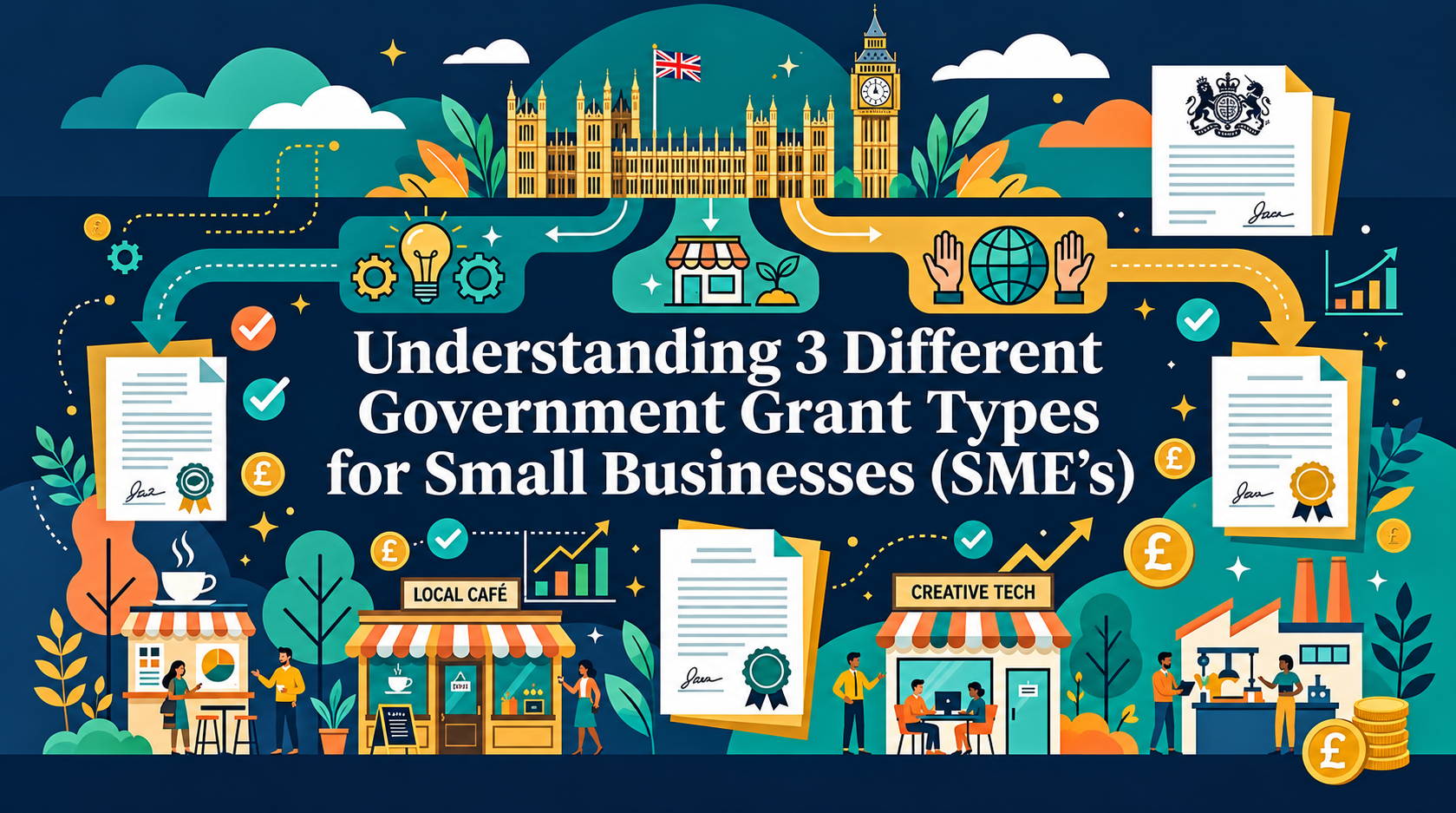
Government grants are often what one thinks of when discussing government funding, and that is what we will focus on today as we explain the 3 main types of government grants available to small business owners in the UK.
Keep in mind that while government grants are available, they are not always accessible to all businesses or for all business funding needs. It is always important to speak to a funding expert before you decide to apply for any government grant schemes.
Top 3 Government Grant Types for Small Business Owners
While government grants are often referred to as just "grants", as in "free money"; there are different types of government grants one should know about. These include:
- Non repayable government grants
- Partial contribution grants
- Conditionally repayable grants
Each government grant is different and has different criteria and qualifications. In most cases these government grants have their own guidelines one must follow in order to become eligible.
Non Repayable Government Grants
The non repayable government grants are often the best type of government grant a business owner can receive in the UK.
These grants are exactly as they sound - non repayable.
Meaning, unlike a loan, the money you obtain from this type of grant programme does not need to be paid back.
However, that doesn't mean that you can just use the funds for anything you want - instead, these government grant types fund very specific needs that a business may have and are provided based on those needs (as long as you are eligible). If the funds are used otherwise, the government may ask for the money back.
 Experts available today
Talk to a real funding expert — not a bot
A real person reviews your business on the call and tells you which grants you qualify for and how much you could get.
- Your eligible grants, answered directly
- How much funding you can apply for
- Programmes open right now
Partial Contribution Government Grants
The partial contribution government grants are great options much like the non repayable government grants. In most cases you will not have to pay the grant back however the "partial contribution" part of it asks that you provide funds of your own as well in order to qualify for the grant.
Sort of like a partnership.
If you need £50,000, the government may give you £25,000 to use towards your funding needs as a non repayable grant but requires that you provide the other £25,000 on your own.
The partial contribution percentage may vary from business to business.
Conditionally Repayable Government Grants
The conditionally repayable government grants are ultimately free money with conditions placed upon them. These conditions can often be negotiated and initially when looking at the grant programme, it may be unclear what these conditions are.
At times they can include stipulations such as:
- No repayment of the grant until profitable
- Partial repayment after 3 years of profitability
- Only repay 10% of the total grant
These conditions are placed on the grant agency and between the business itself and is something to consider and definitely negotiate.
As a small business owner in the UK seeking funding to cover your startup or expansion costs, government funding is definitely a source to consider.
While government grants may be the ultimate "want", they may not be right for you based on your location, industry and the specific funding needs you have. Be sure to work with a UK Startups funding expert to determine if government grants could benefit you and your small business.
About Arjun Patel
Arjun is a business and finance reporter at UK Startups who covers market insights, financial strategies, and economic updates for growing enterprises.