Comparing: Government Grants vs Government Loans
Compare UK government grants and loans for small businesses, explore the different types available, and learn why applying for every suitable funding scheme may improve your chances.

Written by
Arjun Patel
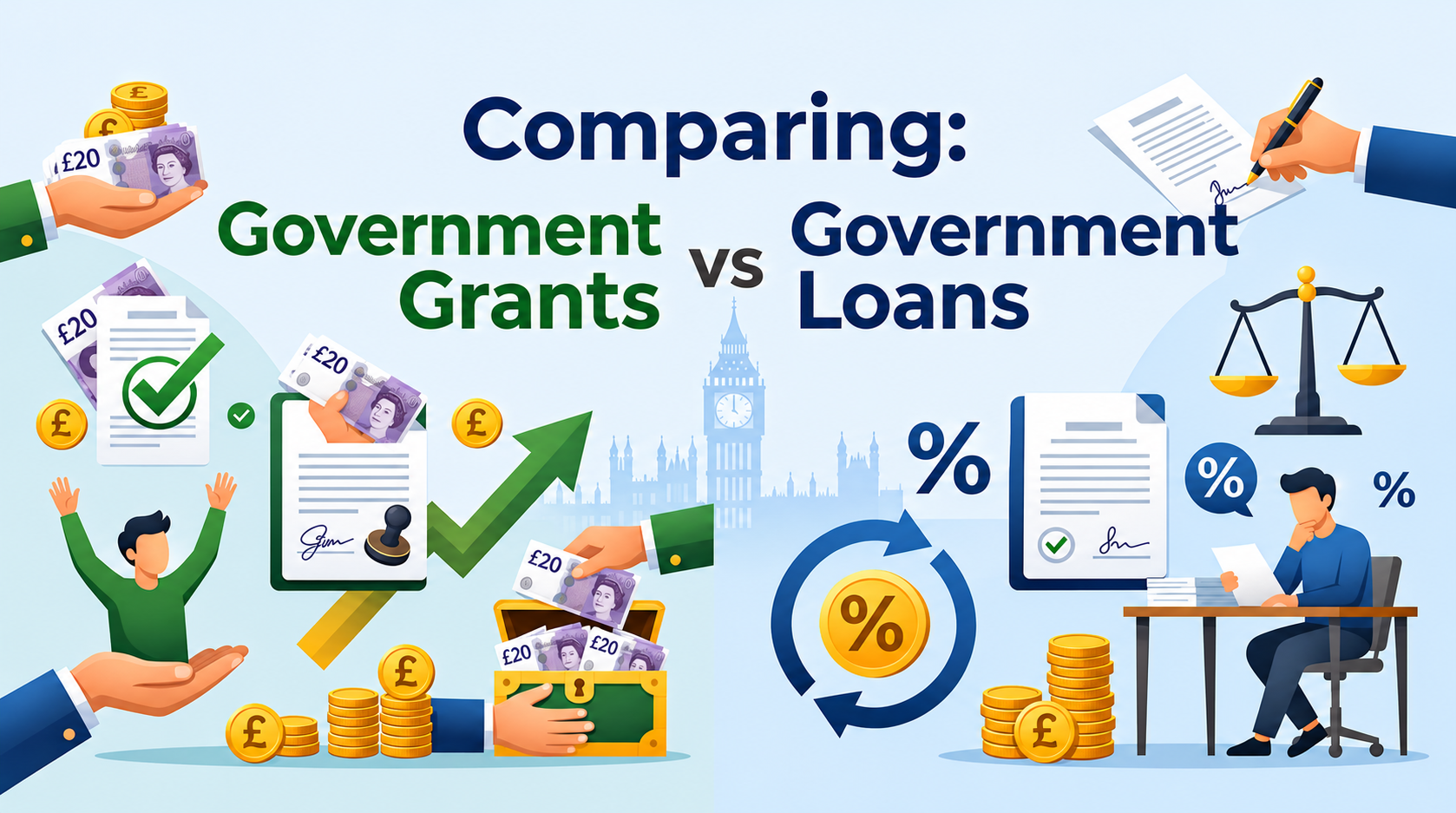
Comparing: Government Grants vs Government Loans
When starting a small business in the UK, one of the first steps of getting started with your small business is to ensure that you have enough capital to be able to do so. Capital, financing, funding, money...all the same, but what is the best way of getting your small business funded?
In this article we are going to compare the two available government funding options. Government Grants vs Government Loans. What is the better choice for your small business, and why?
Comparing Government Grants versus Government Loans:
Before we get started, let's explain the general idea behind each of the two compared types of funding.
Government Grants: government grants or also known as awards, contributions, "funding", "free money", bursaries..etc is funding provided by the government or various government agencies in order to help fund various activities your business may be in need of. Often referred to as free money because the general belief is that government grants is money provided to individual and business owners which doesn't have to be paid back, thus making government grants the prefer choice among funding searchers.
Government Loans: government loans are exactly as they sound, loans - however they are provided by the government and not by individual banks. The government however often has it's own funding schemes which hand out the loans, but in many case the government agencies that provide the loans often team up with the big banks in order to provide the loan to the end consumer (you and your small business).
So is a government grant or a government loan better for your small business?
Government grants, even though referred to as free money, or non repayable money (meaning you don't have to pay it back) is a very lose term. There are many different types of government grants and before you jump and decide that a government grant is the perfect solution for your small business; note the different types of government grants available:
- Non repayable government grants
- Partially repayable government grants
- Conditionally repayable government grants
- Partial contributions
The non repayable government grants are the very best types of grants a small business can obtain. Why? Simple. A non repayable government grant does not have to be paid back. Which means that it is free money provided by the government for your small business.
What are the cons?
Non repayable government grants are extremely difficult to get, and not because they are not available, but because there are so few and the funding purposes that they are made for are limited. And yet, millions of funding pounds are handed out each year to help small business owners with these non repayable government grants.
There are also partially repayable government grants. These grants are only partially repayable as the name suggests. Let's take for example a grant of £10,000. It's possible that the government asks you only to pay back a percentage of the grant (such as 25% of the grant). So technically it's a combination of a government grant and a government loan - but you still keep 75% of the grant without having to pay back. It's also important to note that each funding scheme that offers this type of grant may have different set of terms to abide by.
Next we have conditionally repayable government grants. These are grant that are repayable, like a loan, however they have specific conditions as to when the money has to be paid back, how much has to be paid back and all of the specifics of the grant. The conditionally repayable grants are usually negotiable, so as the small business owner applying to a funding scheme of such nature, be ready to negotiate and set your terms (realistic terms).
 Experts available today
Talk to a real funding expert — not a bot
A real person reviews your business on the call and tells you which grants you qualify for and how much you could get.
- Your eligible grants, answered directly
- How much funding you can apply for
- Programmes open right now
Last type of government grant we are going to discuss is a partial contribution. This is another very good type of grant for a small business to obtain, however it does require a little bit of money on your behalf initially. For example, as a small business owner you may be able to get a partial contribution of £50,000 from a government agency (money you don't have to pay back), but with the condition that you put in a percentage of your own money or match the government deposit. The different government agencies may have different terms, so be sure to read those before you apply.
Now that you know a little bit about government grants, lets discuss government loans.
Government loans are a easy way to get your small business funded and started. There are many different types of government loans that you as a small business owner may be able to obtain. Let's take a look at some of those:
- Low interest government loan
- No interest government loan
- Government guaranteed loan
A low interest government loan is often one of the most provided government loans that small business owners across the UK obtain. Majority of the loans provided by the government agencies are low interest government loans. These government loans come with much better terms then a bank loan would.
Another type of loan is the no interest government loan. No different then a low interest loan, but with specific terms as to the percentage of the interest or term of no interest. Many small businesses who are successful at obtaining this type of loan end up obtaining it with no interest for the first year of business, at which point the loan matures and interest rates (industry standard) will kick in.
The last type of government loan we are going to cover is a guaranteed government loan. Not to be confused with the idea that you are guaranteed a loan (no matter what), instead a guaranteed government loan is the principal that the government or the specific government agency will act as a co-signer on your loan from the bank. Sort of like having your parent co-sign your first car because you didn't have good enough credit or enough money. By doing this, you agree to the terms of the bank plus the terms of the funding agency, but at the same time the funding agency takes on the risk of having to pay your loan shall you not be able to make payments.
So what is better, a government grant or a government loan?
Most of the time as a small business looking for funding you don't really get to chose if you want to get a grant or a loan, instead you apply for what is available and what you can get. That's not to say that you shouldn't only want a grant, or only want a loan - but many times funding depends on a number of factors such as your location, industry and funding needs; and once you break it down by these factors the schemes that are left is what you may be able to apply to (it can be grants or loans).
Many small business owners opt for only grants and are often denied as it's less likely to obtain in comparison to a loan. There are far less grants then loans, and in the end it's a numbers game. So when you are applying for funding, be sure to apply for all available funding schemes that may be right for you.
About Arjun Patel
Arjun is a business and finance reporter at UK Startups who covers market insights, financial strategies, and economic updates for growing enterprises.