5 Rookie Mistakes When Applying for Government Funding
Learn how to avoid five common application mistakes, from choosing the wrong UK funding scheme to missing deadlines, so your small business can improve its chances.

Written by
Arjun Patel
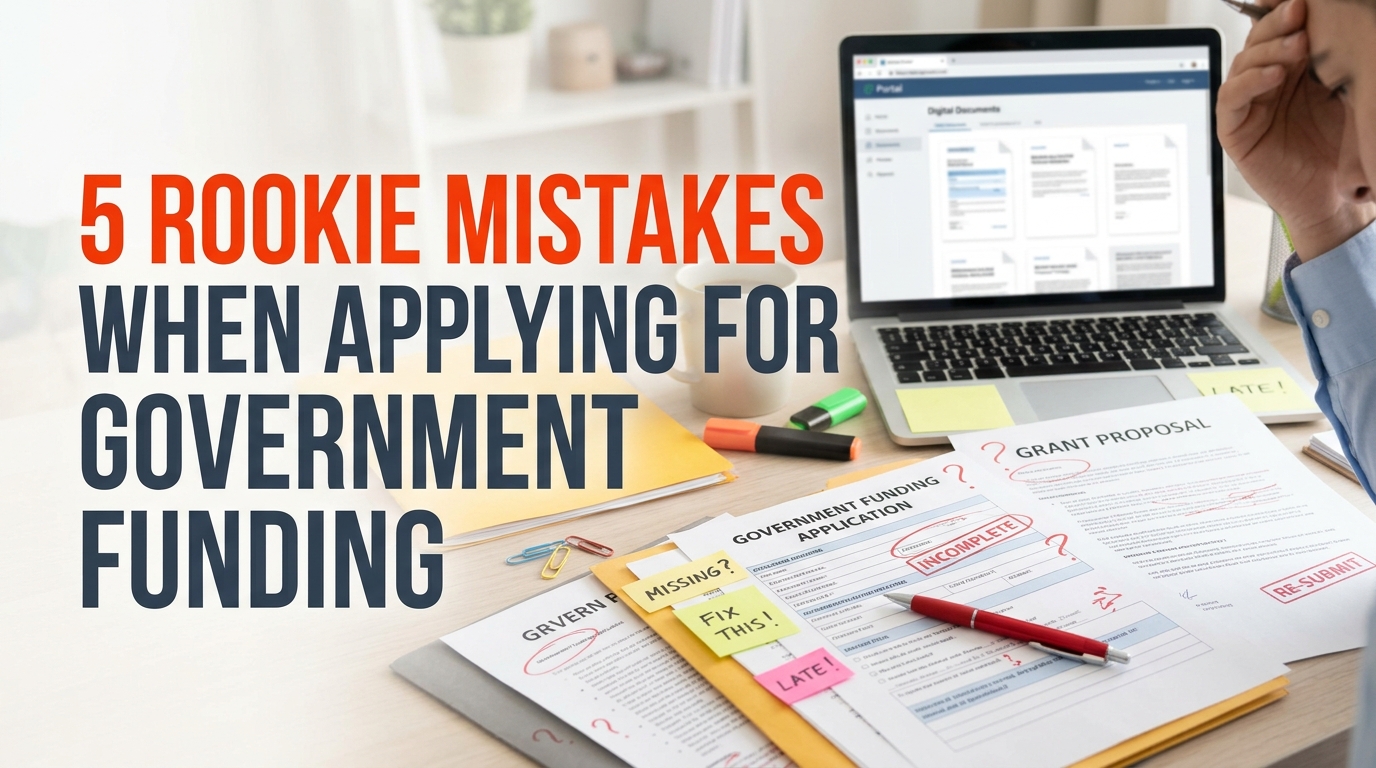
5 Rookie Mistakes When Applying for Government Funding
As a small business, getting funding from the government could mean the difference between success and failure.
The available government funding helps small business owners start up and expand their businesses by covering the various small business costs and expenses.
These funding options, once approved can help the business exponentially. To ensure success, when applying for government funding options, every measure you can take to apply correctly., should be made.
Nearly 80% of the funding applications that are denied by the various government funding agencies across the UK, are often denied due to application mistakes and issues related to the same.
Most of these mistakes can be avoided, so be sure to read on to see the top 5 mistakes when applying to government funding options.
5 Mistakes When Applying for Government Funding
Mistakes are mistakes and often, we learn from our mistakes in order to improve. However, some mistakes are more costly then others, especially those that have bigger consequences.
Take for example a small business that needs money in order to survive, to pay it's staff and the only thing standings between success and fairly is a successfully submitted application.
Wouldn't you want to ensure that you whatever it takes to avoid that mistake?
Well, let's start with the 5 most common mistakes when applying for the government funds:
- Applying to the wrong funding option
- Missing the deadlines (or applying too early)
- Not completing all sections of the application
- Lacking supporting documentation
- Assuming "they know" what you mean
In certain cases, mistakes are just dumb, where people lack the common sense knowledge, but others can be accidental, or due to inexperience, but these 5 are the most common that cause a failed government funding application.
So let's review each one individually, in a bit more detail.
Applying to the wrong funding option
There are MANY different government funding schemes available across the UK. Local options, regional options as well as the national funding programmes.
It's not always easy to pick the best one or to even find the options, so when you do, make sure it is applicable to you.
Many funding applications are denied simply because the individual applying is not qualified or eligible to apply. So read the programme requirements before you try.
Does the programme fund your specific business type?
Is it available in your location?
Is it the correct option for your industry?
Does your funding amount requirement match what they provide?
If a programme exists only for startups (under 2 years); who want to hire staff and are in the medical industry, you as a farmer (with 10+ years in business) and looking to purchase equipment should not apply. It's not relevant and your application will be denied.
 Experts available today
Talk to a real funding expert — not a bot
A real person reviews your business on the call and tells you which grants you qualify for and how much you could get.
- Your eligible grants, answered directly
- How much funding you can apply for
- Programmes open right now
Missing the deadlines (or applying too early)
It's exciting when you start the applications. It means you are one step closer to the money - the money that can make a difference in your business.
But it is a good idea to practice patience and determine the programme deadlines. A good rule of thumb is to apply 2-3 weeks prior the funding programme deadline; so your application is not at the bottom (being too early); or at the end (risking being last).
If the applications are due in a few days; changes are you will be too late so always consider applying on time (giving yourself 2-3 weeks) just in case, to avoid being denied.
Not completing all sections of the application
Some funding applications are easily done - in a few steps; while some may be pages upon pages. Whatever the case may be, the applications and all sections will need to be completed in full in order for you to be eligible.
Unless you are given the option to skip certain steps, it is crucial that no section is left blank; otherwise the application will be considered incomplete, and often denied.
If the applications are digitally completed; in most cases, the applications will be reviewed automatically; which will result in immediate denial if incomplete.
Lacking supporting documentation
One of the biggest factors that plays a huge role in government funding application denials is forgetting to add supporting documentation.
Most government funding agencies will ask that you submit a business plan, a pitch deck, or financial statements at the very least. Going in without these, you risk being denied funding.
If an agency says a business plan and 3 year financials is a must; this is exactly what you must provide; anything less, will result in a funding application denial.
Assuming "they know" what you mean
Full sentences, unless otherwise stated, to explain your business model will always be ideal. Do not assume that the reader of the applications will go top to bottom; but instead, they may skip point to point. So always a good idea that each section has a full, proper explanation and an in-depth answer to the question.
Always, always avoid making answer such as:
"See my response above..."; or "As explained previously"...etc
Avoid using industry terminology or abbreviations that only you would know; and try to dumb it down to a simple and easy to understand level.
Trying to avoid these top 5 common pitfalls and mistakes to government funding applications will help you.
While there are many more mistakes people can make, trying to take your time, or work with an expert on your application can always help you improve your chances of getting funded.
About Arjun Patel
Arjun is a business and finance reporter at UK Startups who covers market insights, financial strategies, and economic updates for growing enterprises.